Microsoft announced the first version of SQL Server 2017 to run on Windows Server, Linux and Docker on Ignite, yesterday, calling it one of the heroes of ‘our new choice paradigm’. It will be available to customers from October 2, 2017, onwards.
SQL Server 2017 is a milestone that was in pipeline since 2016 when Microsoft first announced about planning to make SQL Server available on Linux. The new Server adds features from the data science and NoSQL, and offers cross-platform capabilities and Docker container compatibility for ease of index maintenance, high availability, and data warehouse performance.
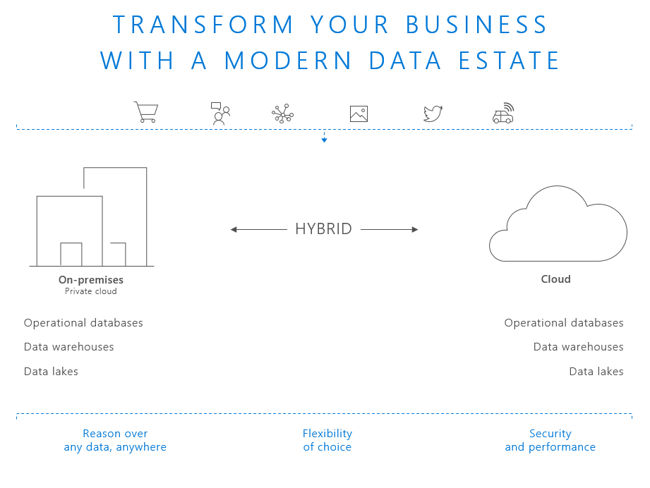
Credit/Source: Microsoft
The new Linux Server 2017 comes with some cool features, as described on the official blog.
• ‘AI built-in, with R and Python analytics plus native scoring in T-SQL – SQL Server was the first commercial database to have AI built-in. SQL Server 2017 enables you to build intelligent apps using scalable, parallelized and highly performant analytics using both R and now Python. New native scoring in T-SQL lets you score in near real-time.
“Beyond the addition of Python as a language that can used for the scoring process, T-SQL code itself can now perform "native scoring" as well, using the language's new PREDICT function. As long as the models being scored against have been trained and are stored in the database in the prescribed RevoScaleR or RevoScalePy format, T-SQL can be used to score against them, whether or not R or Python is even installed on the server. This allows for a very important separation of concerns, whereby Data Scientists can build and train ML models in their own environment, then store them in the database, where any developer can write T-SQL queries to score against them. And if the SQL Server host has Graphical Processing Units (GPUs) on board, data scientists can see even bigger gains, beyond elimination of data movement, by training their models there.
• SQL Server 2017 will enable customers to use graph data management and analysis in order to discover new kinds of relationships. You can track and analyze highly interconnected data, for uses like detecting financial fraud or understanding pharmaceutical drug interactions.

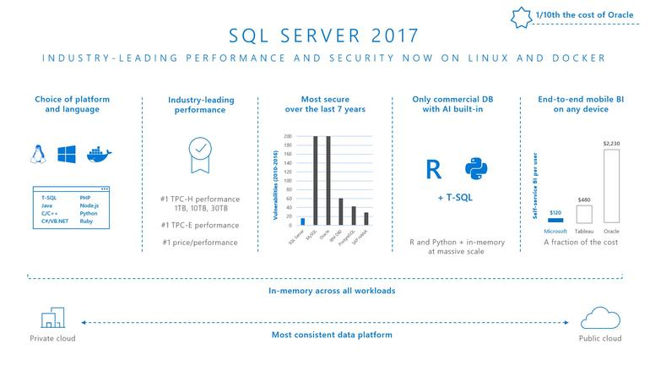 Source: Microsoft